Thursday, June 11, 2015
The Generosity of Others
I have much to thank for the generosity of acquaintances!
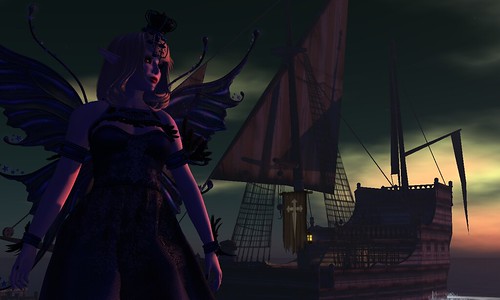
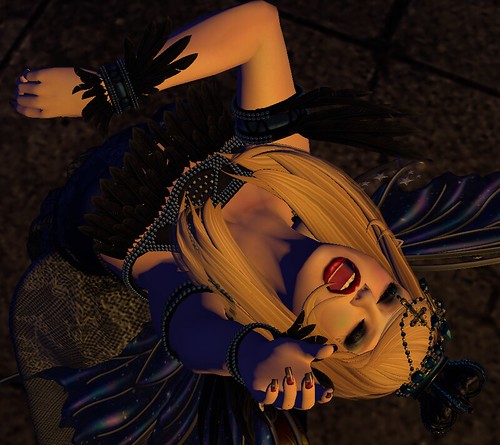
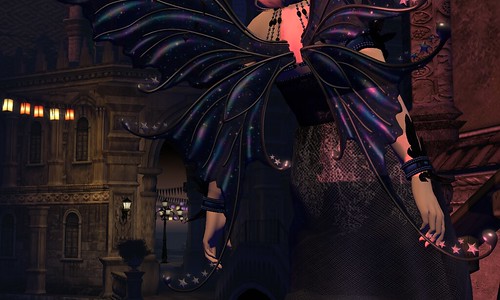
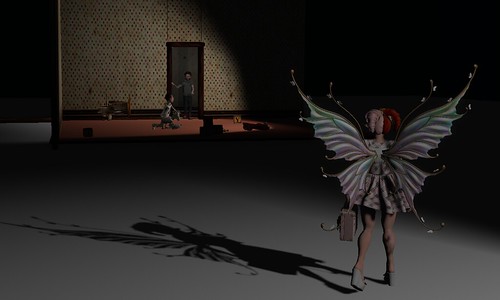
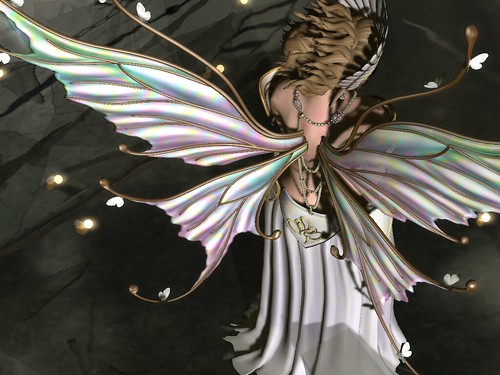
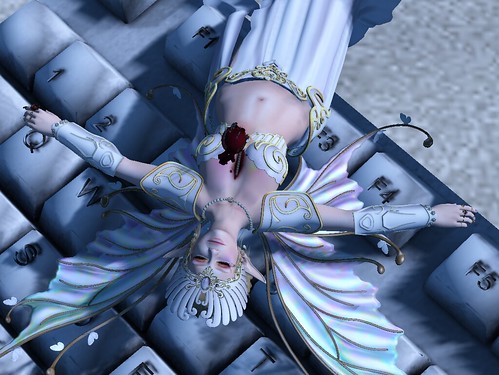
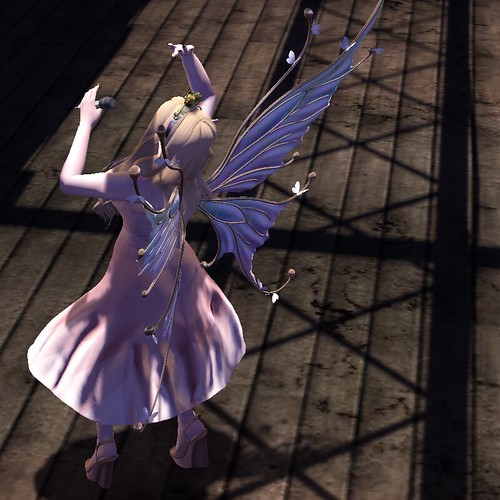
In this case, a lovely individual passed me more lovelies than I could imagine - a balm to my money-tightened nerves. I haven't been able to indulge in gacha recently, but nonetheless I have this adorable feathered vest/collar from .aisling., and I was able to pick up all of the attached commons on the cheap through the various gacha yard sales. I'm ending up with a lot of inexpensive bracelets and armlets thanks to the proliferation of gacha markets and the bottom falling out of the common trade, which can be really a lot of fun to mix and match. In this case I stayed within the same set, though - a highly feathered and beaded confection with truly sublime options for color change - multiple options for the beads and two sections of cloth and feathers both. I adore the fact it offers so much room for customization; it adds a zing to what seems on the surface to be a simple accessory set, a hallmark of .aisling.'s eye for detail. I went almost monochromatic for this shoot, though, which doesn't show off the options but does show off the style, all delicate beading and curved feathers. I especially love how the vest fits around my wings, a delicate touch I always revel in when I can accomplish it. Wings in Second Life may be able to pass unchanged through cloth, but it's so lovely when I can accomplish what verisimilitude exists in fantasy.
And what better way to indulge in fantasy that enjoying the fading days of the sim Venexia, which I explored once before. It's closing in only a few days - a sadness as it is a lovely and unique setting - but I'm enjoying exploring once more and trying to capture some of the wistful mystery of the landscape before it vanishes into the ether. You have to pick up a visitor HUD to visit the ground floor, but they are free and it is definitely worth the extra effort. Venexia has always reminded me of Venice, a city which haunts my dreams in whispers; the formal buildings, lines of hanging lanterns, and shimmers of water catching the light from any angle. A sister-sim, Goatswood, is also closing pretty soon so I'll be swinging through there pretty soon and I'd encourage others to as well. I wish there was a way to catch the attention of the Lindens when exceptional builds like this are vanishing from the grid, but in a world where the dollar is Queen, we all must dance before her throne.
Ziki Questi has some gorgeous pictures up on both landscapes, and Living in a Modem World announces that the creators are working on an Open Sim project called NeverWorldX that will be focused on detailed fantasy roleplaying.
Monday, June 8, 2015
LEA 1: Bryn Oh's "Obedience" - The Binding of Isaac
What, if anything, is the culpability of the watcher?
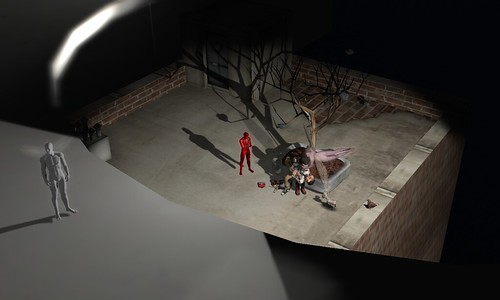
By making you complicit in the events around the Sacrifice of Isaac and aligning you with a God about which the click of shutters echoes, Obedience asks this very question. You have, quite literally, no power to interfere; the events continue unabated whether there are watchers or not, but select spaces between the narrative dioramas react to your presence. Boxes rise up, music plays, lights flash, an eerie spotlight follows you as you move - all of these things highlight not the story but your presence around it. It was the moment when I realized the light was following me, when I saw how I existed in relation to the half-cone of story behind me, that I felt the haunting effect of watching a tragedy with no hope of interference.
Frequently, visitors lingered in the shadows almost invisible next to the familiar story of Abraham loving, learning, enticing, and almost killing his son. The sheer variety of avatars moving through these dioramas offer their own surreality, especially when there ended up being a slow train of movement from one lighted area to the next with the expected pauses on the edges of light. Bright whites and dark shadows combine for a virtual, almost tangible chiaroscuro effect that expands to envelop each visitor as they pass through. And such a diverse flow of people - from the default avatars of the utterly noobed to couples in little more than lingerie - art aficionados in Second Life are like no others.
Like the importance of light, sound is also central to the story. Many of the sections have an appropriate sound-scape. The tinkly lullaby of the first scene, where Abraham's finger in Isaac's mouth eerily echoes the penultimate interaction between them, is at once comforting and threatening. Abraham's Burning Bush is a television, one which offers up static, commercials, and a husky voice whispering a command. With foreshadowing as thickly laid as the shadows, Isaac tells his father about his love of the ram toy he has, and the curve of it's horns which keeps it from harming others. The echoing repetition of "Holy" can be heard before you enter heaven, but it is only when you get close to the penultimate dramatic scene that you hear the winged female spirit - the only woman in the entire story - whispering, "Do not lay a hand on the boy. Do not do anything to him. Now I know that you fear G-d because you have not withheld your son - your only son."
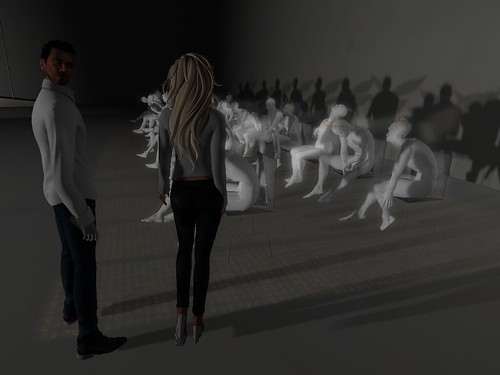
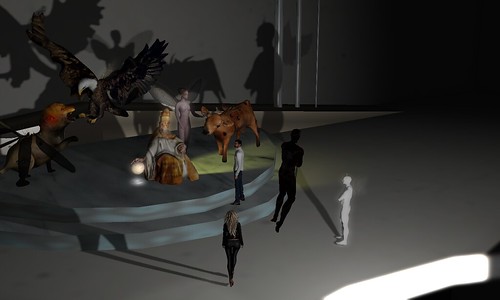
By far the most active section is this Heaven where a motionless Throne and surrounding, eye-festooned creatures are worshiped by an ever-changing army of winged ken dolls, chalky white save for the gold crown on each head. Only a few of the waiting Presence Choir walk to the throne. Alpha, crouching pensively before his calm approach and graceful bow. Charlie, with his pensive pause and florid genuflection. Echo, casually approaching before going down on one knee. Golf, gesturing expansively to his fellows before striding over and summoning a familiar, blue planet. India, gesturing hopelessly before timidly approaching the Throne and falling to his knees. As visitors approach the final area, their shadows fall over the Choir itself, mingling with the rest. As my visit lengthened, I found myself watching others interact - watching where they stood, what they looked at - as much as I watched the inexorable tide of figures playing out their pattern.
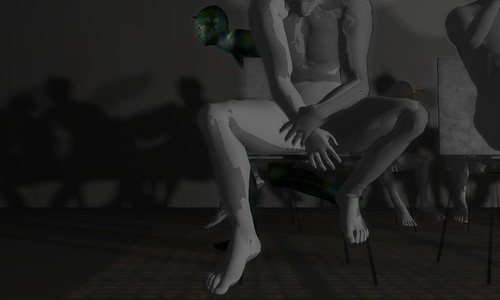
Two other alternating figures play out their own dance, approaching first the disturbing moment of Abraham making good his murderous intentions, then the Throne itself, and then creeping between the static rows of chairs holding the Choir. One, Abecedarian, has a devilish exterior that is constantly shifting in color. The pattern remains consistent each time - red as he surveys the attempted murder and approaches the throne, cyan as he crawls away and crouches to watch the distracted Choir shifting to blue as he crosses in front of them, and then he turns green as he creeps between the two rows only to rush back to red as he runs back toward the Throne. Apprentice is less changeable but oddly more disturbing as, out of all of the moving figures in this diorama, he looks the most like a typical Second Life Avatar. To watch him echo the path of Abecedarian is unnerving - a reminder of how easy it is to enter another avatar's rut.
Standing at the edge of an open view into the most frightening moment of Isaac's life, listening to the incessant click of the camera, I was reminded of the ethical quandaries faced by journalists and documentarians - the question of when to photograph and when to help. There was the story of an imbedded journalist in the Middle East who ended up on a flight rescuing soldiers on the front lines - who photographed as the medics she had spent her time with frantically tried to save the life of a soldier, only to fail. The man making a documentary about war in Africa who photographed the torture and murder of a man, only to learn it was done for his benefit. The question of when, and how, and to what extent people whose job it is to watch should interfere is the lived reality of thousands of people, and thousands more watch when we could act out of self-interest, ignorance, laziness, indecisiveness, or the fear of making things worse.
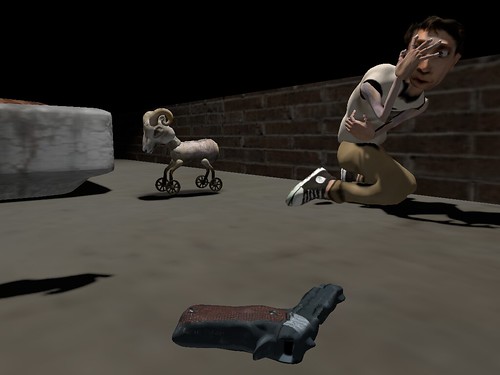
The story of Abraham and Isaac has always bothered me for the subordination of parental love in such a profoundly violent manner, and the final image of Obedience shows the aftermath of Abraham's actions as Isaac cowers away from him. Unlike the previous scenes, which could be reached by walking from one to the next, this one is found through teleportation - either the candy in Isaac's lunchbox, a ball in the stairwell, or a ball in the apartment that Abecedarian and Apprentice emerge from. Boy, Ram, and Gun exist at a distance from Abraham, who is reaching out as he did on the stairwell up. One wonders is Isaac will ever trust his father again.
And above it all, the watchers watch.
By making you complicit in the events around the Sacrifice of Isaac and aligning you with a God about which the click of shutters echoes, Obedience asks this very question. You have, quite literally, no power to interfere; the events continue unabated whether there are watchers or not, but select spaces between the narrative dioramas react to your presence. Boxes rise up, music plays, lights flash, an eerie spotlight follows you as you move - all of these things highlight not the story but your presence around it. It was the moment when I realized the light was following me, when I saw how I existed in relation to the half-cone of story behind me, that I felt the haunting effect of watching a tragedy with no hope of interference.
Frequently, visitors lingered in the shadows almost invisible next to the familiar story of Abraham loving, learning, enticing, and almost killing his son. The sheer variety of avatars moving through these dioramas offer their own surreality, especially when there ended up being a slow train of movement from one lighted area to the next with the expected pauses on the edges of light. Bright whites and dark shadows combine for a virtual, almost tangible chiaroscuro effect that expands to envelop each visitor as they pass through. And such a diverse flow of people - from the default avatars of the utterly noobed to couples in little more than lingerie - art aficionados in Second Life are like no others.
Like the importance of light, sound is also central to the story. Many of the sections have an appropriate sound-scape. The tinkly lullaby of the first scene, where Abraham's finger in Isaac's mouth eerily echoes the penultimate interaction between them, is at once comforting and threatening. Abraham's Burning Bush is a television, one which offers up static, commercials, and a husky voice whispering a command. With foreshadowing as thickly laid as the shadows, Isaac tells his father about his love of the ram toy he has, and the curve of it's horns which keeps it from harming others. The echoing repetition of "Holy" can be heard before you enter heaven, but it is only when you get close to the penultimate dramatic scene that you hear the winged female spirit - the only woman in the entire story - whispering, "Do not lay a hand on the boy. Do not do anything to him. Now I know that you fear G-d because you have not withheld your son - your only son."
By far the most active section is this Heaven where a motionless Throne and surrounding, eye-festooned creatures are worshiped by an ever-changing army of winged ken dolls, chalky white save for the gold crown on each head. Only a few of the waiting Presence Choir walk to the throne. Alpha, crouching pensively before his calm approach and graceful bow. Charlie, with his pensive pause and florid genuflection. Echo, casually approaching before going down on one knee. Golf, gesturing expansively to his fellows before striding over and summoning a familiar, blue planet. India, gesturing hopelessly before timidly approaching the Throne and falling to his knees. As visitors approach the final area, their shadows fall over the Choir itself, mingling with the rest. As my visit lengthened, I found myself watching others interact - watching where they stood, what they looked at - as much as I watched the inexorable tide of figures playing out their pattern.
Two other alternating figures play out their own dance, approaching first the disturbing moment of Abraham making good his murderous intentions, then the Throne itself, and then creeping between the static rows of chairs holding the Choir. One, Abecedarian, has a devilish exterior that is constantly shifting in color. The pattern remains consistent each time - red as he surveys the attempted murder and approaches the throne, cyan as he crawls away and crouches to watch the distracted Choir shifting to blue as he crosses in front of them, and then he turns green as he creeps between the two rows only to rush back to red as he runs back toward the Throne. Apprentice is less changeable but oddly more disturbing as, out of all of the moving figures in this diorama, he looks the most like a typical Second Life Avatar. To watch him echo the path of Abecedarian is unnerving - a reminder of how easy it is to enter another avatar's rut.
Standing at the edge of an open view into the most frightening moment of Isaac's life, listening to the incessant click of the camera, I was reminded of the ethical quandaries faced by journalists and documentarians - the question of when to photograph and when to help. There was the story of an imbedded journalist in the Middle East who ended up on a flight rescuing soldiers on the front lines - who photographed as the medics she had spent her time with frantically tried to save the life of a soldier, only to fail. The man making a documentary about war in Africa who photographed the torture and murder of a man, only to learn it was done for his benefit. The question of when, and how, and to what extent people whose job it is to watch should interfere is the lived reality of thousands of people, and thousands more watch when we could act out of self-interest, ignorance, laziness, indecisiveness, or the fear of making things worse.
The story of Abraham and Isaac has always bothered me for the subordination of parental love in such a profoundly violent manner, and the final image of Obedience shows the aftermath of Abraham's actions as Isaac cowers away from him. Unlike the previous scenes, which could be reached by walking from one to the next, this one is found through teleportation - either the candy in Isaac's lunchbox, a ball in the stairwell, or a ball in the apartment that Abecedarian and Apprentice emerge from. Boy, Ram, and Gun exist at a distance from Abraham, who is reaching out as he did on the stairwell up. One wonders is Isaac will ever trust his father again.
And above it all, the watchers watch.
Genre (Anime): Cherry Blossom Decadence
There are many themes which Anime has brought out of Japan, and one of the most evocative and enduring is cherry blossoms. They represent ephemeral beauty, not simply of the "Nothing gold can stay" variety, but of the swift death of the warrior in pursuit of her ideals. In Japan, early spring is the time of Hanami where friends and families gather together under the cherry blossom trees to eat, drink, and celebrate - a tradition that goes back for centuries. Gifts of cherry trees were given to the United States after World War II and planted around the Tidal Basin there among the monuments to presidents Thomas Jefferson and Franklin Delano Roosevelt, as well as the memorial for Martin Luther King, Jr. There is nothing quite like that double row of trees - one above the rim of the basin in an endless curve, and the other reflected back as the water gently laps against the wall.
My introduction of the cherry blossom as something brief, beautiful, and redolent of death was through CLAMP, a famous quartet whose many stories made the leap from drawn material to anime. It's difficult for me to say which of their many creations is my favorite, but my love hops nimbly between Card Captor Sakura (one of their gentler Magical Girl series), Tokyo Babylon (side story to X/1999 whose focus is the love between a pure boy and a cruel man), CLAMP School Detectives (another X/1999 side story, completely unrealistic and enormously fun), Angelic Layer (a Magical Girl story once removed), and xxxHolic (a mind-bender of a series, and companion to Tsubasa: Reservoir Chronicles). Cherry blossoms take a central roll in Tokyo Babylon; the two main characters, Subaru and Seishirō, meet under a cherry in full bloom and death and beauty haunt their entire, destructive interaction. I find the melding of sweetness and murder enticing, and all of that is contained within a cherry blossom.
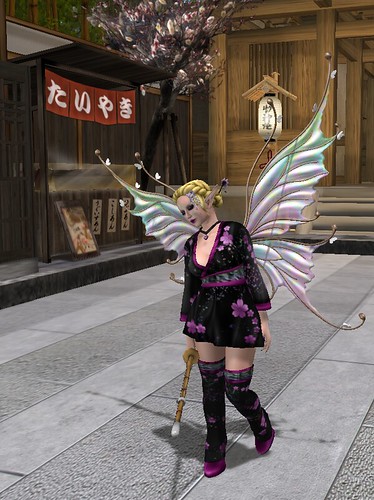
It seemed appropriate for me, therefore, to settle on cherry blossoms for my second look from this month's Genre. Vengeful Threads' kimono-inspired mini dress is covered in pink cherry blossoms on a black field. The wrap dress has a wide belt, reminiscent of an obi without having the same straight shape; the color-blocking harkens back to other traditions without hewing too closely to them. I love the long leg-warmer boots, and the distance between the hem of the skirt and the top of the sock is just wide enough to be evocative. I couldn't resist the lure of impractical clothing with weaponry, though, so I added a bamboo shinai from Souzou Eien - also available at Genre. This is a wonderful, basic training sword and comes with three included poses that can be switched between by tapping the sword. You can also do what I did, and have it go along for the ride as you pose!
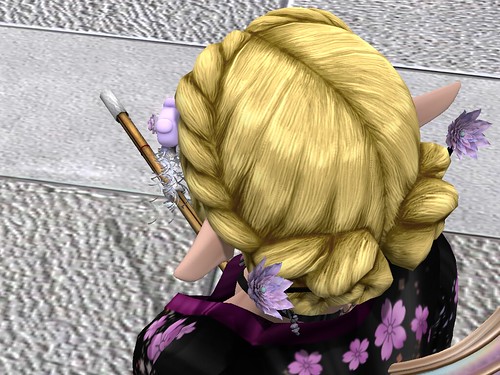
I went simple for the hair, choosing a solid, unrigged mesh style from Chimeric Fashions, who typically does some rather wonderful masks. It's a twist updo with large buns in the back, and since it's a single object it's easy to resize to fit a variety of head shapes. I particularly appreciated the big buns as they gave me a place to tuck hair sticks from Distorted Dreams; the lavender was a touch less pink than the rest of my look, but it made for a softer counter-point to an otherwise bright ensemble. There are two versions - one with beaded dangles and the other without - and my only complaint is that I don't have them in every color of the rainbow! I'm a total sucker for hair sticks. They default to facing forward, but I found it easy to shift and reposition them to the back of my head instead, and they can easily be adjusted to work with any hairstyle. Adding a third lavender accent is a tiny, floofy and cute doll from Muse that I fit against the front of my head. The little flower and ribbon bedecked ornament might not quite fit with my ...ruthless presentation as a cherry blossom assassin, but my love of sparkles and adorability won out over all other considerations.
Labels:
Chimeric Fashions,
Distorted Dreams,
Genre,
Muse,
Second Life,
Souzou Eien,
Vengeful Threads
Sunday, June 7, 2015
Sunday Squee: A:S:S Nail Polish
The Sunday Squee is when I can talk about things that make me happy and excited. The main focus will be on different things people created, from books to movies to television shows to podcasts, and my effort will be to highlight less commonly known things as a way to share what I love. If you want to join in the Sunday Squee, please link back to me so I can enjoy what you love!
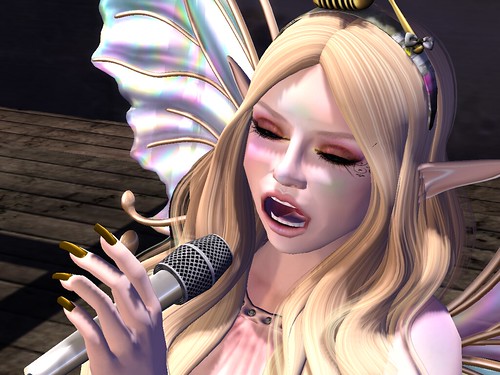
It was a challenge to select three images for this post highlighting A:S:S's dramatic nailpolish style. I'm only showing three of a truly impressive panoply - at the top is an example of his graphic designs, drawing from inspirations like gemstones and (as shown above) butterfly wings. These are by far the most unlikely nails offline, requiring either wraps or steady hands and a lot of time, but in world they're available at the touch of a button. For obvious reasons, the butterfly variants (ah! if only there was a rainbow one!) are one of my favorites, but the Gold Thread abstract designs and the crisp lines of his pastel Tiara and bright Rainbow are equally striking and work with a variety of outfits, either as a complement or a contrast. Sometimes he adds in more subtle textures, like the seemingly embossed Royal Purple, or the Victorian Velvet I need to pick up soon, and the variation in texture given he's working with a static surface and has to accommodate different lengths of nail is impressive.
He does equally well with solid colors, as you can see above, and earns my eternal gratitude by usually including all six of the main rainbow colors; orange and gold are in shorter supply in my inventory, so when I need them I almost always turn to A:S:S. He also makes a mean teal, and when I can find perfect matches to one of his colors, well... its bliss. These single colors, either dark or pastel, are among the more offline-realistic of his shades, but there are also some which straddle the line like his Superglitter nails or the Mahi Mahi sparkle-tips shown below. I've actually replicated a Mahi Mahi adjacent look offline with a brighter color - it has to do with layering glitter-polish over a solid shade. For the realists among us he even offers up a set of chipped polish in shiny and matte, in addition to his basic shades and dirty nails.
A:S:S is mostly known for his mens clothing - and believe me, someday when I'm feeling generous I'll be back to kit out my poor mAlt Quatre - but his nails are wonderful for the ladies as well, and they really make me happy! I also feel the need to note that there are lucky boards in his nail store, and I and the alphabet alts may be making a showing in the next few days in the drive to get me shiny, glorious nails.
It was a challenge to select three images for this post highlighting A:S:S's dramatic nailpolish style. I'm only showing three of a truly impressive panoply - at the top is an example of his graphic designs, drawing from inspirations like gemstones and (as shown above) butterfly wings. These are by far the most unlikely nails offline, requiring either wraps or steady hands and a lot of time, but in world they're available at the touch of a button. For obvious reasons, the butterfly variants (ah! if only there was a rainbow one!) are one of my favorites, but the Gold Thread abstract designs and the crisp lines of his pastel Tiara and bright Rainbow are equally striking and work with a variety of outfits, either as a complement or a contrast. Sometimes he adds in more subtle textures, like the seemingly embossed Royal Purple, or the Victorian Velvet I need to pick up soon, and the variation in texture given he's working with a static surface and has to accommodate different lengths of nail is impressive.
He does equally well with solid colors, as you can see above, and earns my eternal gratitude by usually including all six of the main rainbow colors; orange and gold are in shorter supply in my inventory, so when I need them I almost always turn to A:S:S. He also makes a mean teal, and when I can find perfect matches to one of his colors, well... its bliss. These single colors, either dark or pastel, are among the more offline-realistic of his shades, but there are also some which straddle the line like his Superglitter nails or the Mahi Mahi sparkle-tips shown below. I've actually replicated a Mahi Mahi adjacent look offline with a brighter color - it has to do with layering glitter-polish over a solid shade. For the realists among us he even offers up a set of chipped polish in shiny and matte, in addition to his basic shades and dirty nails.
A:S:S is mostly known for his mens clothing - and believe me, someday when I'm feeling generous I'll be back to kit out my poor mAlt Quatre - but his nails are wonderful for the ladies as well, and they really make me happy! I also feel the need to note that there are lucky boards in his nail store, and I and the alphabet alts may be making a showing in the next few days in the drive to get me shiny, glorious nails.
Friday, June 5, 2015
One Amazing Event that Will Never Happen Again
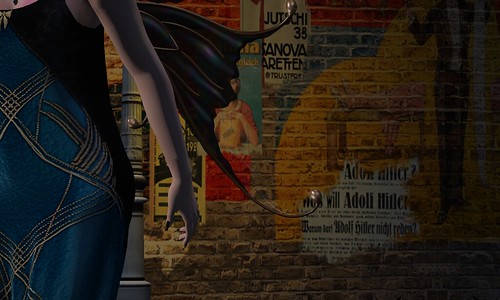
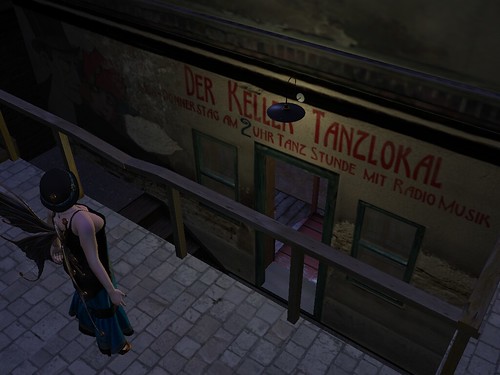
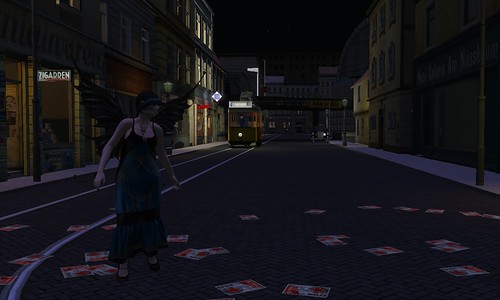
For only twenty-four hours, non-humans could visit 1920's Berlin. The invitation came with a caveat - it applied to everyone, residents and non - but it was a rare chance for me to check out a sim I've been hearing about for years, and into which only the CEO of Second Life could venture without appropriate attire. I had occasionally played with the idea of setting up a 1920's alt, Volstead has wearable demos which are free and both Bliensen + MaiTai and Eclectica offer accessories at a reasonable price, but never got around to it. When I heard I could go in wings and all, though, I kitted myself out in an old fashioned hobble skirt and cloche hat before winging my way over for a look and some pictures.
The 1920's were a rare moment in European and US history, a brief window of cacophonous freedom before the 1929 Stock Market crash. Women were building on the gain made by suffragettes over the previous decades, and the young took their new independence and ran with it. You can think of the style of this period as a recoil from the voluminous gowns and hour glass shape of the Victorian and Gibson women. Jo Yardley attempts to recreate the Weimar Republic in all of its conflicted glory, from the demands placed on women on the street to cover up - at risk of drawing police attention! - to the wild parties in the speakeasies and the subversive Cabaret. It was central to the German Expressionist movement which embraced the unrealistic and highly emotional. Even now their tropes are the foundation for modern horror and film noir, dark and dramatic genres which could only be intensified by the horrors soon to follow. The portrayal of humans as a source largely for malevolence, where even the honorable are stained, seems reasonable in this context.
By the time I arrived it was late night and Berlin was deserted - a maze of streets and courtyards which defied light. A few stores sold clothing and accessories in the distinctive style of the era. Women's fashion tended toward the boyish, the freedom-seeking New Women of the previous decades embodied by the young seeking independence and enjoyment. Women's dress revisited the square silhouette in rebellion against the hourglass of previous decades, this time with a dropped waist and the removal of the corset altogether. Hemlines rose - but not too much; the mini-skirt was still fifty years in the future, and knees remained more hinted at than brazenly shown. Bobbed hairstyles became prevalent, sometimes with fingerwaves, other times with elaborate curls that followed the contours of the skull. Inside one of the buildings in 1920's Berlin was a maze of barber's chairs, the hairstyles of the era covering the walls. The highly decorated, broad brimmed hats of the past gave way to narrower, tighter styles like the distinctive cloche or newsboy caps. Cosmetics tended to be high contrast - bright or dark reds and oranges against pale skin. Men were still decked out in suits, but might be more likely to incorporate bright colors or patterns into their ensemble, and within the night clubs and cabarets even more boundaries than color might be crossed.
The German Kabarett was a darker riff on a French confection - song, dance, and costume combining with razor social critique and gallows humor. The aesthetic was cynical and detached, and while the lessening of governmental controls allowed for greater communication, the defenses of sarcasm and irony remained intact. Demands for change and critique of the contemporary order were combined with wild partying, and when people wanted to dismiss calls for sexual and racial equality, it was the partying they highlighted. Black entertainers from the United States fled to Europe where discrimination was less woven into the warp and weft of society, bringing with them their music, dance, and dress and those seeds found fertile ground to inspire the next wave of creativity across Europe. Jazz was brought to Berlin by artists like Josephine Baker in her tour across Europe. Dances like the Charleston supplanted the waltz of previous decades. The Charleston's roots are in the Juba dancing inspired by West African culture and was performed by slaves on Plantations, and the systemic practice of black dance becoming gradually more mainstream and less identified with the people who began it continues to this day with twerking, a move found in the mapouka dance of West Africa. Sadly, racism was still present in Berlin; while black entertainers may have done well, black residents were described by the local racist elements as being tolls for the equally hated Jews, sent to destroy Europe via miscegenation.
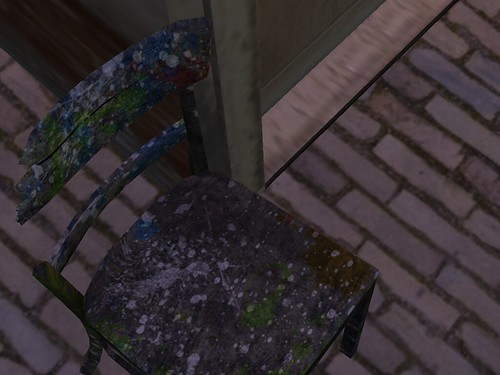
In Second Life's 1920's Berlin, Frau Yardley attempts to capture in amber a contradictory and tumultuous time in history, the moment when so many competing forces were coalescing in a shining moment of light and sound before war descended again. Within Second Life, a requirement for verisimilitude, for faithfulness to a vanished past, can be realized again. I have mixed feelings about demanding historical fidelity - my own forays into the virtual are much less tied to mortal flesh and I have reservations about attempting to replicate the offline world without reflecting on who and what is left out. Second Life is an overwhelmingly white place within it's humanity, and the exclusion even of the fantastical things white people can dream up seems like a further symptom of this narrowing in the name of immersion or authenticity. For an hour, though, a fae walked the streets of Berlin, pausing in it's alleys and snapping images of it's painted chairs, and for now that will have to satisfy my desires for transgression.
As you may be able to tell by the title, I've been thinking a lot about Canary Beck's writing on SEO - and the opportunity for one of her signature titles was too strong to resist. This is highly likely to be a one time event as well; the style of title may be evocative and good SEO, but I can only engage with it ironically.
Tuesday, June 2, 2015
How NOT to Make Friends and Influence People in Second Life
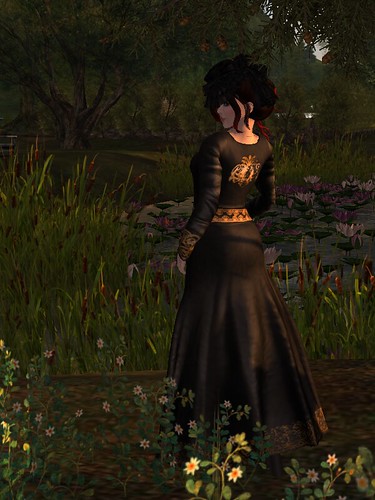
Recently, I had reason to head to a Sandbox on an alt of mine, the lovely medieval Nineveh (named for the ancient city, of course, though I'm a few millennia off in how I dress her). Usually I don't interact much with the fellow people - walk in, unpack boxes, walk out. This time I was lingering a bit longer, mostly because I was distracted and depressed, when a few things happened to divert me further. Warnings for language below the cut, and a rather rude conversation as well.
Monday, June 1, 2015
Sunday, May 31, 2015
Sunday Squee: Tea
The Sunday Squee is when I can talk about things that make me happy and
excited. The main focus will be on different things people created, from
books to movies to television shows to podcasts, and my effort will be
to highlight less commonly known things as a way to share what I love.
If you want to join in the Sunday Squee, please link back to me so I can
enjoy what you love!
One of the funny things about Sunday Squee is that it's as much a promise to myself as anything else - a desire to find something positive enough to write about every week.
This has been a very hard week to be Squeeful.
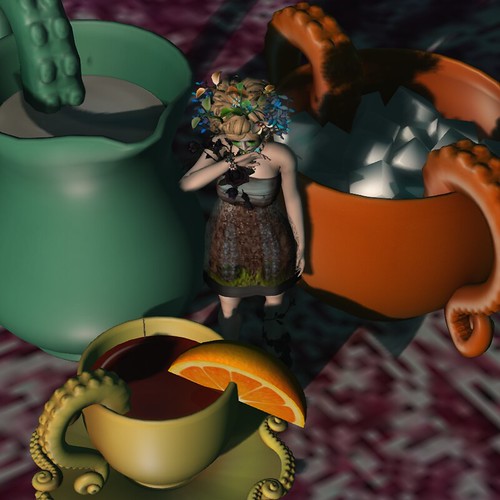
And so I retreat to a longstanding favorite - warm tea served with proper milk and sugar in the appropriate containers. My set at home is silver - a family heirloom - but these cephalopods ones are from a gacha tea set from Schadenfreude. I love their wriggly bits, and I'm still sad I didn't manage to get the entire set. They're best with little pastries on the side, flaky and warm with perhaps a cream and lemon filling. The whole ritual of tea making, from warming the cup, to steeping the tea, to pouring out over a little filter, to the slow sips as one stares into space letting the flavor of the tea sooth every sore edge.
I love a wide number of teas, from the oolong which won my heart, to the white teas whose delicate flavor inspires daydreams, to blooming teas which create art in glass and water.
Join me in a cup?
One of the funny things about Sunday Squee is that it's as much a promise to myself as anything else - a desire to find something positive enough to write about every week.
This has been a very hard week to be Squeeful.
And so I retreat to a longstanding favorite - warm tea served with proper milk and sugar in the appropriate containers. My set at home is silver - a family heirloom - but these cephalopods ones are from a gacha tea set from Schadenfreude. I love their wriggly bits, and I'm still sad I didn't manage to get the entire set. They're best with little pastries on the side, flaky and warm with perhaps a cream and lemon filling. The whole ritual of tea making, from warming the cup, to steeping the tea, to pouring out over a little filter, to the slow sips as one stares into space letting the flavor of the tea sooth every sore edge.
I love a wide number of teas, from the oolong which won my heart, to the white teas whose delicate flavor inspires daydreams, to blooming teas which create art in glass and water.
Join me in a cup?
Saturday, May 30, 2015
Whatever I Fear
Whatever I fear the most is whatever I see before me
Whenever I let my guard down, whatever I was ignoring
Whatever I fear the most is whatever I see before me
Whatever I have been given, whatever I have been
Whenever I let my guard down, whatever I was ignoring
Whatever I fear the most is whatever I see before me
Whatever I have been given, whatever I have been
Did we expect these things to change
By waking up and suddenly there they are
And all I need's a starting place
And nothing ever seemed so hard...
Monday, May 25, 2015
How do we Tolerate Intolerance
The 2015 Eurovision Song Contest is a bright and frothy reflection of very dark things. I didn't want to get into it in my Sunday Squee because it is decidedly unSqueeful, but the Eurovision attempt to sing away war happened while a war was going on. Over a year ago, in February 2014, Russian forces invaded Ukraine in the wake of Ukraine trying to formalize stronger ties with Europe, and they've continued to advance their military despite sanctions from a West which has been unwilling to offer up direct military aid. Conflict News, a source which attempts to use citizen reporting about what they observe as a way to get more information about conflicts in areas where journalists are unsafe, has a running line of information about the ongoing conflict on their Ukrainian feed, including an animated gif which gives a sense of the war's size and progression. It is notable that Ukraine had withdrawn from the Eurovision Song Contest citing their unstable political and financial position while Russia remained in the contest, and scored second with a charming song I would have loved if not for the political backdrop.
In addition to Russia showing their intolerance of Ukraine's independence through war, Russia has also spent the last several years spreading prejudice about some of their citizens and codifying the abuse of these same citizens into law in 2013. There are a lot of ways to interpret this in the face of a West which is becoming increasingly liberal about homosexual people, and to a lesser extent trans* gender people, it came briefly to the attention of a national stage during the 2014 Olympic Games in Moscow but was overshadowed by the attack on Ukraine in 2014. Vladimir Putin defended Russian law as being put in place to encourage population growth in Russia and even contextualized responses to Russia's codification of discrimination of law as foreign propaganda (source). Lithuania pointedly had two same-sex kisses as a highlight of their song This Time, a narrative choice which would have been strengthened by keeping that lineup the whole time instead of prefacing and following it with the expected heterosexual couples. The moment - and the cheers of the crowd - seemed extremely pointed, however, given Russia's contemporary treatment of gays and lesbians.
And it is into this context that the points scoring section occurred, where the crowd booed when Russia received points - and it happened a lot, since the Russian song and singer were very good. The hosts of the show emphasized several times that “music should stand over politics tonight”, and last year's winner Conchita Wurst, who had been condemned by the Russian Orthodox Church, was seen comforting singer Polina Gagarina who had supported Wurst despite Russian condemnation in the wake of Wurst's 2014 win. Against this backdrop, in the context of individual people making connections while larger countries shift in focus, the question of how we respond to intolerance becomes even more important. It is notable that Gagarina was condemned along with Wurst within Russia and yet was still chosen to represent Russia. Whenever one is talking about a country there is a mix of people with directly opposing beliefs, and all too often a minority of the population can use violence or bureaucracy to monopolize the representation of the country. It's also important to keep in mind that we can use discrimination in other places as a way to draw attention from the local discrimination we condone, offering up a mirage of effortless moral superiority. Where I live in the US the legal discrimination has lessened, but there are still horrible and cruel things done to lesbians, gay men, bisexual people, as well as the broader spectrum of people with variable gender identities.
Discrimination is an act of individuals, but it is also an act of a collective, and so neither individual nor collective response is sufficient. I think that is why these moments can be so fraught, as thousands of people mistook Gagarina for Russia and booed, as other people defended Gagarina hoping the larger context would ally them with the accepting and not the intolerant. To object to something is an act of discrimination, and act of intolerance, and so often that simple fact is used as a weapon against people who object to anything - including intolerance. We don't live in a fairy tale world where the character of the king is reflected in his country, but we do live in a world where the many often go along with the few, and where objecting to the public face of a presumed majority is discouraged. We also live in a world where feelings may be mixed. Even knowing that Gagarina supported Wurst despite the words of prominent people in the country she is representing, I found that the very act of her representing Russia was an emotional challenge for me. I didn't want to like her or her performance - they were very good nonetheless - and despite their inaccuracy in the specific moment, I found the audiences' refusal to let Russia's actions against other countries and it's own citizens go unrecognized.
Emotionally, I would have preferred if one of the bridges built was to Ukraine, even though Ukraine could not be present. Mentioning them, honoring them, would have done a lot to rebalance things in my opinion. Instead, the unmarked absence of Ukraine and the presence of the country which caused their absence felt like cheering on the bully while ignoring the person he put in the hospital - I found it intolerable. Clearly, the powers that be behind Eurovision felt differently - and given the reactions of the women who were the face of Eurovision this year, it felt like one which was congruent for them even while it was intolerable for me. The call to "Build Bridges" while people were being killed seemed painfully tone deaf despite the sheer joy I found in Eurovision. I think that particular flavor of tolerating intolerance by pretending it did not affect any of the people involved - in this case by trying to filter out the booing which was used by residents of the local area to register their dislike for Russia in the face of it's intolerance and aggression - was unreasonable.
I don't know how things would have gone differently if the Eurovision staff had created something recognizing Ukraine as a sibling nation and marking their absence, but I would imagine that it would have added to the individual acts by other countries, like Lithuania, which attempted to mark the intolerance they disliked by displaying a type of public approval of same-sex relationships, or like France and Hungary did with their songs decrying war. The presence of Wurst was an explicit condemnation of Russia as well, but I wish both Wurst and Gagarina had respected the voices that disagreed with the inclusion of Russia in the larger context. Gagarina's song was "A Million Voices," and I am sure her intentions and her desires for peace and healing are sincere, but I think calling for peace and healing while people are dying in their own countries and that isn't being recognized by the people calling for peace and healing is, again, unreasonable.
A Million Voices should include the people currently being victimized, the people currently being attacked, the people having their children taken away, the people losing their jobs. It should include a country that was attacked and whose resources were drained so they couldn't attend. The Bridge to them shouldn't vanish, while the Bridge to their attacker is maintained, or this isn't true peace, this isn't true healing - it is a call for solidarity on the backs of the dying and dead, and that's no solidarity at all.
Context matters.
Subscribe to:
Posts (Atom)